
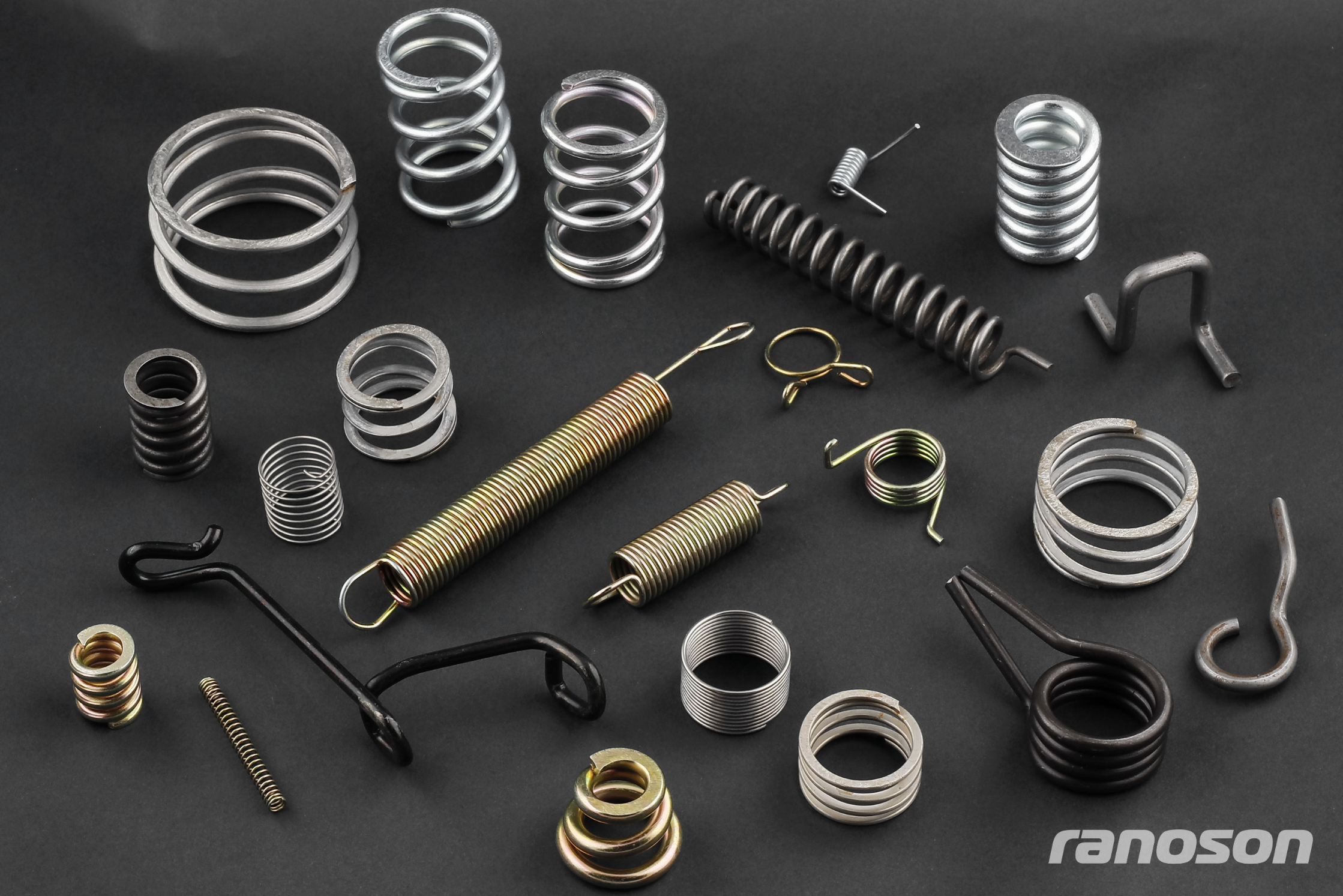
7 Reasons Springs Are Critical to Industrial Automation Systems
Posted on: 13 Dec, 2025
Industrial automation is often discussed in terms of software, sensors, and control systems. Yet, the reality is that none of these systems work reliably without a solid mechanical foundation and stability. Behind every precise motion, repeatable cycle, and controlled force, there is usually a spring doing quiet, essential work.
From robotic arms to automated assembly lines, springs play a direct role in efficiency, accuracy, and equipment life. Let’s break down the seven crucial ways springs matter so much in automated environments and where their impact is felt most.
1. Springs Enable Controlled Motion in Automated Systems
Automation depends on repeatable motion. Springs provide controlled resistance and return force that motors alone cannot achieve efficiently. In pick-and-place units, actuators, and linear motion systems, springs help regulate movement, absorb inertia, and return components to their neutral position. (E.g., Constant force springs are often used for counterbalancing loads, reducing the required motor torque).
What this really means is smoother operation. Instead of relying entirely on motors for braking and positioning, springs share the load and reduce mechanical stress.
2. They Improve Accuracy and Positioning
In robotics and automated tooling, positional accuracy is everything. Even small deviations can lead to misalignment, part rejection, or tool damage. Springs help maintain consistent contact pressure, alignment, and preload in mechanisms such as clamps, guides, and fixtures. Precision compression springs, for example, maintain constant preload on fixtures to prevent part shift during high-speed cycles.
This is especially important in high-speed automation where components cycle thousands of times a day. A well-designed spring keeps tolerances stable even as conditions change.
3. Springs Absorb Shock and Vibration
Automated machines operate at high speeds and often experience sudden starts, stops, or direction changes. Without proper shock absorption, these forces transfer directly into the structure, leading to wear, noise, and early failure.
Springs act as mechanical buffers. They absorb impact energy, damp vibration, and protect sensitive components such as sensors, bearings, and actuators. This includes both shock absorption (handling sudden impact) and vibration isolation (reducing harmonic frequencies). Over time, this directly improves machine uptime and reliability.
4. Decrease Energy Consumption and Extend Motor Life
Motors are expensive and sensitive components. When springs are integrated correctly, they reduce the continuous load on motors by handling part of the force requirement. This applies to counterbalancing, return motion, and maintaining tension or compression.
Lower motor load means reduced energy consumption, less heat generation, and longer motor life. For large automated systems, this translates into measurable operational savings.
5. Springs Support Safety and Fail-Safe Functions
Safety is a core requirement in industrial automation. Springs are often used in fail-safe mechanisms that activate when power is lost or systems shut down. Emergency stops, braking systems, and safety latches rely on spring force to move into a safe state automatically. A common application is power-off brakes on servo motors, where the spring actively engages the brake until power is applied to release it.
This mechanical reliability is critical. Unlike electronic controls, springs respond instantly and predictably, even during system failures.
6. They Enable Compact and Efficient Design
Automation equipment is getting smaller, faster, and more integrated. Springs make compact design possible by delivering force without large actuators or complex assemblies. A single custom spring, like a custom torsion or flat spring, can often replace multiple mechanical parts while maintaining performance and saving space.
For OEMs and system integrators, this means lighter assemblies, fewer components, and simpler maintenance.
7. Custom Springs Adapt to Automation Demands
No two automation systems are the same. Cycle rates, loads, temperatures, and duty cycles vary widely across industries. Standard springs often fall short in these environments.
Custom-engineered springs allow designers to match force, deflection, fatigue life, and form factor to the exact requirement. This is where precision manufacturing becomes critical. A spring that performs consistently over millions of cycles is not an off-the-shelf decision. It is an engineering one.
Strategic Considerations: Why Quality and Sourcing Matter
In automated systems, a spring failure rarely stays isolated. It can cause misfeeds, sensor errors, tool crashes, or complete line stoppages. Downtime in automation is expensive and disruptive.
High-quality springs are manufactured with controlled wire forming, accurate dimensions, proper finishing, and verified performance. They are tested for load consistency, fatigue life, and repeatability. This attention to detail is what separates reliable automation from unstable systems.
What OEMs and Sourcing Managers Should Consider
When evaluating springs for automation, consider more than just unit cost. Look at critical performance factors such as cycle life, consistency across batches, and the supplier’s ability to meet tight tolerances at scale. The initial cost of a cheap spring is minor compared to the cost of line downtime.
A dependable spring partner understands automation demands and works closely with your engineering and production teams to ensure long-term performance.
Moving Automation Forward
Automation continues to evolve, but its foundation remains mechanical reliability. Springs may be small components, yet they directly influence efficiency, accuracy, safety, and cost.
Choosing the right spring design and manufacturing partner is a strategic decision, not a minor one. It shapes how your automation systems perform today and how reliably they scale tomorrow.
If you are building or upgrading automated systems, it is worth revisiting how springs are specified, tested, and supplied. The ROI from specifying high-quality, engineered springs is significant.
Let’s build automation systems that move with control, precision, and confidence.
Springs: The Unsung Heroes of Reliable Automation.
📧 sales@ranoson.co.in
📞 +91 7895010088 | +91 7217013190