
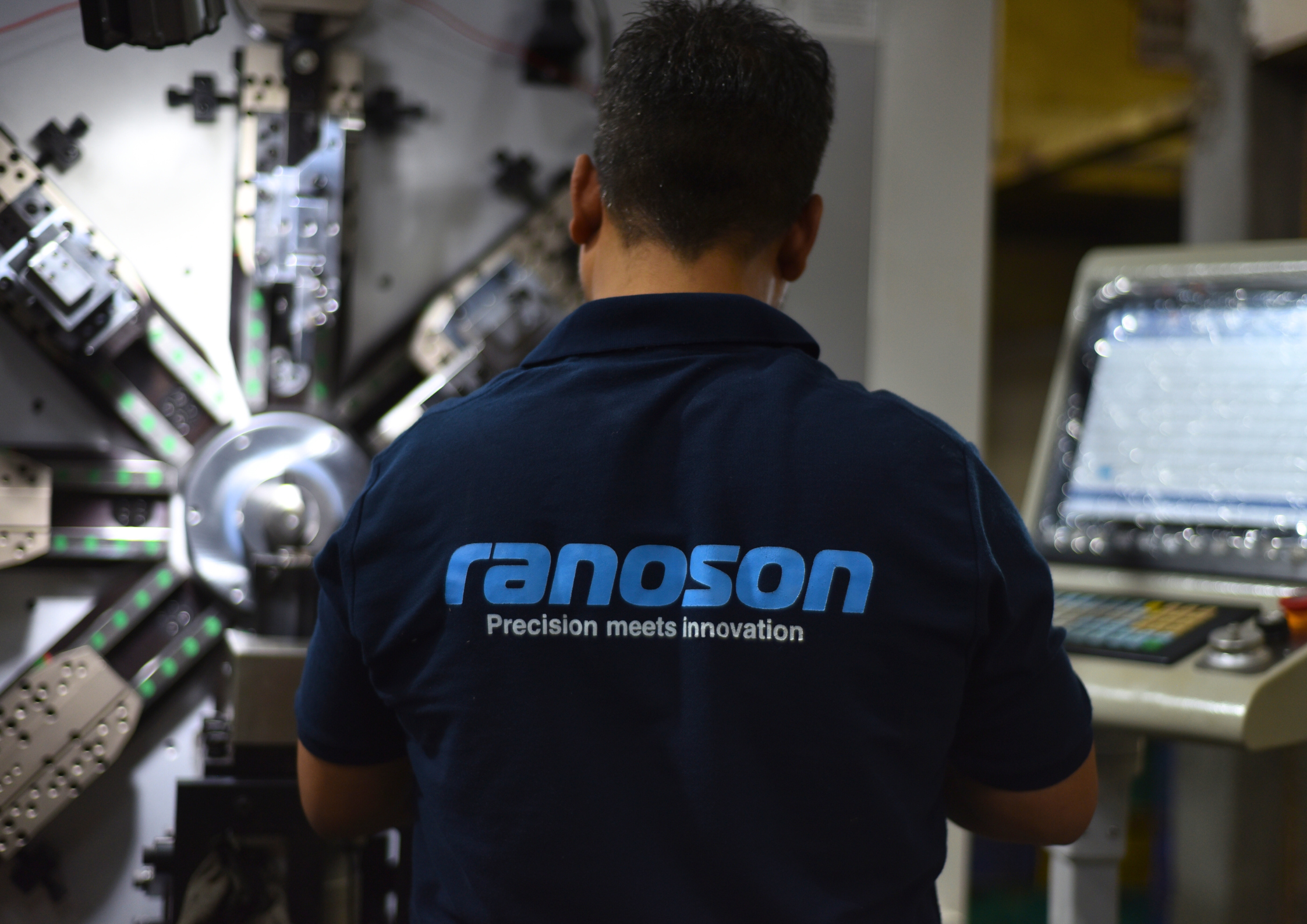
The Top 5 Challenges in Large-Scale Spring Production
Posted on: 07 Nov, 2025
Mass-producing springs might sound straightforward. You set up a machine, run the material, and parts roll out by the thousands. But anyone who has worked in manufacturing knows that maintaining consistency, quality, and efficiency at that scale is anything but simple. In large-scale spring production, even a small variation can turn into a major issue when multiplied across tens of thousands of units.
At Ranoson, we’ve been through the grind of scaling up while keeping precision intact. Here are the five biggest challenges manufacturers face in high-volume spring production, and how we’ve learned to overcome them.
1. Material Variation and Quality Control
Every batch of wire is slightly different, even when sourced from the same supplier. Variations in tensile strength, surface finish, or coil uniformity can affect spring performance. When you’re making thousands of springs, those small differences can lead to inconsistency in load, fatigue life, or dimensions.
To solve this, we rely on strict incoming inspection and material traceability. Each wire batch is tested before production starts. We record hardness, diameter, and surface finish, then match process parameters accordingly. Consistent input means consistent output.
2. Maintaining Dimensional Consistency Across High Volumes
Large-scale production amplifies even the smallest deviation. A change of 0.1 mm in coil diameter can cause fitting or performance issues in assembly. Manual adjustments and tool wear over time can also create dimension drift.
At Ranoson, we control dimensional accuracy through process discipline and continuous inspection. Our CNC and multi-axis coiling systems are programmed with tightly defined parameters, and every production batch goes through dimensional checks using precision measuring instruments. Operators monitor coil geometry at defined intervals, and any deviation triggers immediate correction. This consistent feedback loop keeps dimensions stable even when volumes scale up.
3. Tool Wear and Machine Calibration
Tooling takes the most stress in large-scale production. As dies, mandrels, and guides wear down, springs start showing slight shape inconsistencies or surface scratches. Poor maintenance schedules only make this worse.
Here’s the thing. Preventive maintenance is not optional. We maintain machine calibration logs, schedule tool changes before wear becomes visible, and monitor tool life through production data. This discipline keeps machines running at peak precision for longer and avoids costly rework.
4. Balancing Speed with Precision
When production targets increase, it’s tempting to push machines to their limits. But higher speed doesn’t always mean higher output. Excessive speed can cause wire feed instability, spring distortion, or even tool breakage.
We focus on the optimum speed-to-precision ratio. Automated coiling machines are tuned for each spring design, ensuring the right balance between throughput and accuracy. It’s about controlled speed, not just fast output. The result is consistency that holds even when volumes go up.
To strengthen this further, we’ve also invested in in-house manufacturing technology through our vertical Ranok Systems. Our CNC and multi-axis coiling machines, built entirely in Bharat, deliver more than double the output of many imported models while maintaining precision and consistency. This independence allows us to optimize production speed, reduce downtime, and keep quality within tight control. Something few manufacturers in the country can claim
5. Heat Treatment and Stress Relief Uniformity
Stress relief is one of the most critical steps in large-scale spring production. If heat distribution inside the furnace isn’t even, springs in different zones can develop varying hardness or residual stress levels. This leads to uneven performance and early fatigue failures in application.
We use calibrated conveyor-type furnaces for uniform heating and controlled cooling. Temperature mapping is part of our standard validation process. By automating the stress-relieving cycle and logging every batch parameter, we ensure that every spring performs the same way. No matter when or where it was made.
Bringing It All Together
Precision at scale is not just about having advanced machinery. It’s about process discipline, data, and people who care about details. At Ranoson, every step, from wire sourcing to packaging, follows a documented process designed to prevent variation. Our investment in CNC and multi-axis forming systems has made it possible to produce high-volume parts without compromising on precision.
What this really means is that we treat large-scale production with the same care as a prototype run. Because when an OEM or Tier 1 supplier installs one of our springs into an assembly, we know that consistency defines reliability.
Watch how spring production takes shape at Ranoson:
Partnering for Precision
As demand for higher production volumes continues to grow, precision spring manufacturers need to balance speed, quality, and reliability more than ever. Ranoson’s large-scale manufacturing setup, backed by strict quality systems and automated processes, ensures that every spring meets its intended performance. Consistently, batch after batch.
Let’s build better performance, together. Talk to our team to see how precision, process control, and consistency can strengthen your supply chain.
📧 sales@ranoson.co.in
📞 +91 7895010088 | +91 7217013190